Are you going to dig deeply? Whether you're building a foundation, a high-rise, a basement, or something underground, when you dig, you can damage the ground and nearby buildings.
To make sense of this, Deep Excavation Monitoring is helpful.
We help you keep an eye on the frost walls and other buildings nearby as you dig, and how the ground moves and settles. Your team can make changes when needed and know what's going on at the job site if they get clear reports and lots of updates.
Why Does Deep Excavation Need Monitoring?
Taking away a lot of dirt can change the way the ground acts around it. This might make things change or calm down in some places.
When people dig near these places, there may be more danger:
- Buildings that are already up
- Roads and streets
- It's simple
- Keeping the walls up
- Pipes and cables that are buried
- Other places to build
As the project goes on, our Excavation Monitoring Services UAE help you keep up with these changes.
Every now-and-then check gives you:
First of all, watch for any strange ground motion. Check the deal.
- Watch out for homes nearby.
- Check to see if the wall is moving.
- Check out what's different from the dig.
- Make the choices for construction better.
- Write down things that will help you with the project.
What do we monitor?
No one way works for all of them to keep an eye on a dig. We look at your project and focus on the most important parts.
Ground Movement
With our Ground Movement Monitoring, you can see if the ground around your dig has changed or is moving.
Seeking a Settlement Monitoring Excavation
Settlement monitoring can be used to track changes in the ground level. This is especially useful for excavating around roads, buildings, structures, or utilities.
Retaining Walls:
Do not remove the walls that support the trench. You can watch them progress as they dig; your team can get a feel for how they're doing.
Nearby Buildings:
Look at the buildings around you to see if anything could change as the work progresses.
Roadwork and service work:
Additional impacts may include adjacent roads, sidewalks, and underground utilities. Things change in such places when you look at them.
How do they do it?
Our Deep Excavation Monitoring Solutions are easy to use and project-oriented.
Let's start by talking about your site.
We examine the dig, the buildings nearby, the ground, and the building plans.
Then we figure out how to monitor things.
We decide what we watch, where we gather data, and how often we check.
Then we get the first reports
These numbers give us a benchmark against which to compare future readings. The building is going up, and we will continue to watch. “They are digging, and at the same time they are making provisions. It is discussed and evaluated. We provide you with clear reports that your project team can use to spot shifts, delays, or changes.
Where do we provide our services?
We can help you with all types of building projects.
When you hire us to monitor deep digs in the UAE, we can help with: Projects in the basement,
- Skyscrapers,
- Commercial development,
- Housing developments,
- Deep foundation projects,
- Subsurface structures,
- Infrastructure projects.
- Building roads,
- Works for utilities,
- Excavations near existing buildings,
- Excavations along roads and footings.
When Should You Opt for Excavation Monitoring?
When you should pay attention to:
- That's a long way to go on your dig.
- A lot of buildings are already there.
- There are roads close to where you work.
- There are services that run below ground.
- It's not far from where supports are already there as they dig.
- Things on the ground for the project are not easy.
This is when regular checks can help your team get a better idea of what's going on at the spot.
What Technology Do We Use?
Different projects need different monitoring methods. The technology that we use depends on the location of your site, the depth of the excavation, the surrounding structures, and the requirements of the project.
Total Station Surveys:
With the Total Station, we can accurately measure the position of selected points around the excavation. It can indicate retaining wall, building, or other structure movement.
Basically, it allows us to see small changes in position that we may not be able to see.
GNSS / GPS Monitoring
GNSS helps track the position of monitoring points across larger areas.
It is useful for large construction and infrastructure projects where movement needs to be tracked over a wider site.
Basically, it helps us see if the points we've picked are moving.
Inclinometer Monitoring
Inclinometers help measure movement within the ground or retaining system.
They are especially useful in deep excavations when the engineers want to know how the soil or retaining wall is moving at different depths.
Simply put, they help us make sense of what is happening beneath the surface.
Monitoring of Settlements:
Settlement monitoring points allow us to check the movement of the ground downward and lateral settlement.
This is important around buildings, roads, foundations, and other structures.
Simply put: It helps us know whether the ground level is changing.
Crack Monitoring
Crack monitoring can be used on existing buildings and structures near the excavation.
It helps track whether existing cracks are changing during construction.
Simply put: It helps us keep an eye on changes in existing cracks.
Automated Monitoring
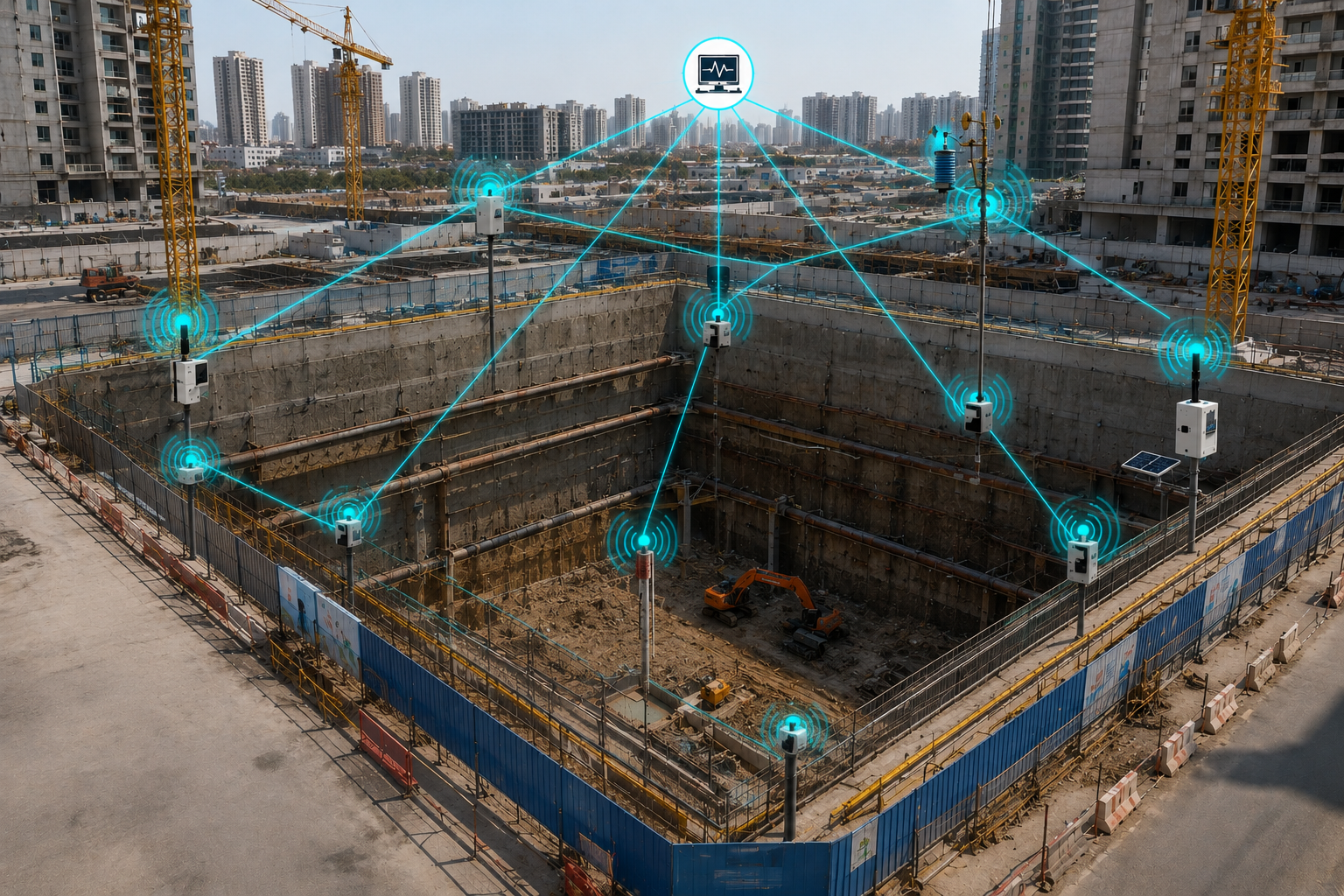
Some projects need measurements more frequently. In these situations, automated monitoring systems can collect information continuously or at planned intervals.
Simply put: It allows the project team to receive monitoring information more frequently without relying only on manual measurements.
Monitoring Software
Monitoring software helps turn large amounts of measurement data into simple graphs, trends, reports, and useful information.
Simply put: It makes the monitoring data easier to understand.
What Are the Benefits?
The biggest benefit of monitoring is simple: you know what is happening around your excavation.
View Changes Early:
Regular monitoring can help to identify early abnormal movement or settlement.
Protect Nearby Buildings
If your excavation is close to an existing building, monitoring can help you keep track of changes during construction.
Watch the Ground Move:
During digging, you can observe the reaction of the ground around you.
Walls of Monitors:
Monitoring can help engineers know if retaining walls are moving or changing during excavation, he said.
Supporting safer building:
Good information helps the project team make better decisions at different points during construction.
Reduce Uncertainty
Instead of relying only on visual inspections, you have actual measurements that can be compared over time.
Keep Your Record Clean.
The monitoring record is useful in that it provides a record of what happened during the excavation and construction process.
What Challenges Can Occur?
Deep excavation projects can be a mystery. Typical challenges include soil condition changes. The ground conditions can differ from one area to another within a site.
Monitoring helps the project team understand ground behavior.
Ground movement or settlement may affect excavation near existing buildings.
How monitoring helps:
Monitoring can be timed with the construction schedule.
Rural areas:
Continued construction may make some monitoring sites more difficult to access.
How monitoring helps:
“Monitoring locations and technologies can be planned in relation to future construction phases.”
Large Amounts of Data
Long projects can generate a lot of monitoring information.
How monitoring helps:
Digital systems make it easier to organise, review, and understand the data.
Changing Construction Conditions
The site may look very different at the beginning of excavation compared with later stages.
How monitoring helps:
The monitoring plan can be reviewed and updated as the project develops.
Why Choose a Professional Deep Excavation Monitoring Company?
To do good tracking, you need to do more than just read the numbers. It must be clear and useful to business leaders.
When you hire a skilled Deep Excavation Monitoring Company, you can:
- You can trust the data from your monitoring.
- A plan to check on your site often
- Usually checked things
- Keep records
- Help with tech stuff.
- Better views of how the ground is moving
- Keeping an eye on the building during key stages
Our only goal is to give you the information you need to feel better about running your dig.
Deep Excavation Monitoring Services in UAE
Drilling jobs come in many forms. What the ground does depends on the type of soil, how deep the hole is, the buildings nearby, and the system in the area.
Our Deep Excavation Monitoring Services allow you to monitor critical changes that occur during construction, customized to your needs.
We can help you choose the best way for your job, whether it's Ground Movement Monitoring UAE, Geotechnical Monitoring Services UAE, or Excavation Monitoring Services in Dubai.
Questions that lots of people ask
How do you keep an eye on deep excavations?
Deep dig monitoring looks at the ground and buildings near a dig, often while it is being built.
Why is it important to keep an eye on excavations?
That means you and your project team can quickly identify changes and how the excavation is impacting the ground and any nearby buildings.
What can be monitored?
Depending on the project, settlement, ground movement, retaining wall movement, buildings, roads, and other structures in the area may be monitored.
Is monitoring useful for basement construction?
“Yeah. This can be very useful in deep basement excavations for projects near roads, buildings, foundations, and underground utilities.
How often do you need to check digging?
For every job, it's different. The frequency of site inspection will depend on the depth of the dig, the condition of the ground, the building schedule, and any surrounding structures.
Are you guys doing deep excavations in Dubai and throughout the UAE?
You can plan tracking services based on what your building project needs and how things are going on the site.
Make sure the digging job doesn't get off track.
It's necessary to dig deep when building, but you don't have to do it if you don't know how.
With the right Deep Excavation Monitoring Solutions, your team can keep an eye on how the ground is moving and settling, and on buildings that are close by, as the project goes on.
For your next job, do you need to keep an eye on a dig? Please get in touch with us today to discuss your requirements.